

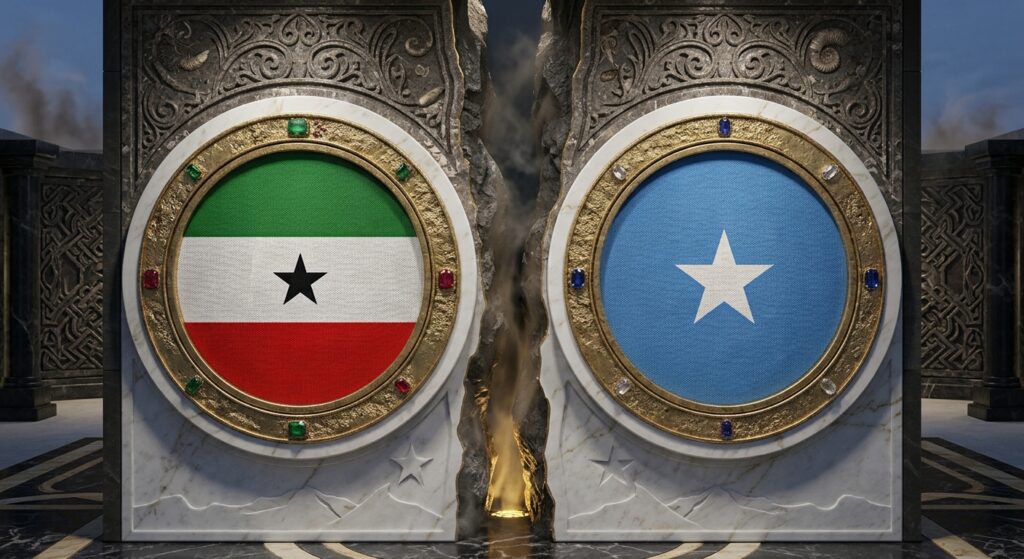
Over a decade of internationally mediated negotiations has demonstrated that technical deals cannot bypass the root dispute between Hargeisa’s pre-union sovereign restoration and Mogadishu’s unitary integrity. As regional alliances realign around the Red Sea corridor, diplomatic realism must replace constructive ambiguity.
The growing chasm between two divergent diplomatic agendas
The dialogue between Somaliland and Somalia, relaunched in 2012, was founded upon two fundamentally irreconcilable conceptions regarding the political destiny of both entities. Mogadishu approached the talks as a domestic reconciliation conduit aimed at safeguarding and restoring the territorial integrity of a unitary Somalia. In contrast, Hargeisa engaged strictly through the prism of two separate political equals negotiating a peaceful mechanism to define their future diplomatic relations. This structural divergence in core objectives has remained the paramount obstacle precluding any comprehensive or definitive political settlement.
A decade of negotiated frameworks – from the early rounds in Turkey to subsequent summits in Djibouti and the recent memorandum of understanding between Ethiopia and Somaliland – underscores an enduring reality: while both parties have occasionally converged on narrow technical issues, they remain fundamentally deadlocked on the existential question: Is the process meant to preserve Somali unity, or is it a framework for managing an orderly and sovereign separation?
This analysis examines the institutional history of these talks, documented pacts, shifting geopolitical dynamics, and third-party mediation efforts. By distinguishing between ratified bilateral accords, diplomatic rhetoric, and substantive geopolitical realities, it illuminates the systemic reasons why technical cooperation failed to bridge the political divide.
The core fault line: contested interpretations of 1960 and 1991
Somaliland’s sovereign claim rests on its documented history as an independent sovereign state following the end of the British protectorate on 26 June 1960, prior to entering into a voluntary union on 1 July 1960 with the former Italian trust territory. From Hargeisa’s vantage point, the reclamation of independence in May 1991 was not an act of secession, but the formal dissolution of a failed union and the restoration of its pre-existing 1960 borders.
Conversely, the Federal Government of Somalia maintains that Somaliland constitutes an inalienable component of the Federal Republic, insisting that constitutional unity and territorial integrity remain non-negotiable principles under domestic and international law.
These polarized starting points created an impasse far more intractable than standard interstate disputes. For Mogadishu, any legitimate outcome must preserve national unity; for Hargeisa, any meaningful settlement must acknowledge its de facto statehood and de jure rights. This fundamental disconnect explains why low-level functional agreements on airspace, transit, and security have intermittently emerged, while a political resolution regarding their ultimate sovereign relationship has remained unapproachable.
The Turkey negotiations: Functional compromises and the status dilemma
Direct dialogue gained institutional momentum in 2012 following the Chevening House discussions in the United Kingdom and subsequent meetings in Dubai. The Ankara Communiqué of 13 April 2013 formalized the dialogue as a bilateral mechanism between the Federal Government of Somalia and the Government of Somaliland, explicitly acknowledging international facilitators while barring foreign interference in the substantive negotiations. This diplomatic framing provided significant legitimacy to Hargeisa, which interpreted it as recognition of bilateral parity between two distinct sovereign entities. Mogadishu, by contrast, regarded the forum merely as an internal dialogue between the federal center and a constituent authority to negotiate reintegration.
The subsequent Istanbul round of talks in July 2013 demonstrated that pragmatic technical compromise was feasible. According to the Turkish Foreign Ministry, both delegations agreed in principle to establish a joint aviation control authority headquartered in Hargeisa to oversee civil airspace. Although initially heralded as a model of practical cooperation, disputes over operational jurisdiction, revenue collection, and institutional dominance eventually turned civil aviation into one of the fiercest bones of contention.
In January 2014, the third Istanbul round sought to institutionalize the process by creating an operational code of conduct, decision-making protocols, and a joint secretariat in Turkey scheduled to convene quarterly. However, formal records attest only to the ratification of these mechanisms, revealing that subsequent execution quickly faltered.
The unraveling of the Turkish agreements exposed systemic fragility. Disagreements over fee distribution, air traffic control towers, and sovereign oversight derailed the aviation accord. When Mogadishu asserted singular jurisdiction under its federal civil aviation authority, Hargeisa accused it of violating signed pacts and acting unilaterally. Consequently, functional cooperation collapsed, and both capitals retreated to entrenched positions.
The 2020 Djibouti Summit: High diplomacy without a final political resolution
The summit convened in Djibouti on 14–15 June 2020 represented an ambitious multilateral attempt to revive bilateral dialogue stalled since 2015. Hosted by President Ismaïl Omar Guelleh, the consultative meeting brought together Somalia’s President Mohamed Abdullahi Farmaajo and Somaliland’s President Muse Bihi Abdi, alongside Ethiopian Prime Minister Abiy Ahmed.
As detailed in the official communiqué released by the Djiboutian Ministry of Foreign Affairs, the gathering prioritized immediate pragmatic concerns, including cross-border trade, freedom of movement, and humanitarian cooperation.
International stakeholders strongly endorsed the dialogue. In a joint statement issued on 16 June 2020, Somalia’s international partners – including the United Nations, European Union, United States, and regional bodies – applauded the leaders’ renewed engagement and urged the newly established joint technical committees to produce tangible, verifiable outcomes.
The joint communiqué agreed on 15–17 June 2020 established a 14-member ministerial committee and three specialized subcommittees on humanitarian aid, civil aviation, and security coordination, mandating an operational review within 45 days. Crucially, while this structure provided a temporary procedural breakthrough, it conspicuously avoided the existential core: sovereign independence versus federal reintegration. The diplomatic optics achieved in Djibouti once again proved unable to mask the unbridgeable political abyss.

The December 2023 Accord and the 2024 Ethiopia MoU Realignment
After extensive diplomatic dormancy, talks resumed on 28–29 December 2023 under the auspices of President Guelleh, bringing together President Hassan Sheikh Mohamud and President Muse Bihi Abdi. The resulting eight-point joint communiqué of 29 December 2023, co-signed by Somalia’s Interior Minister Ahmed Moallim Fiqi and Somaliland’s Interior Minister Mohamed Kahin Ahmed, pledged to establish a 30-day roadmap for substantive talks, honor earlier pacts from Ankara to Djibouti, reaffirm official recognition of atrocities inflicted by the Siad Barre regime upon northern populations, and cease antagonistic public statements.
However, mere days later – on 1 January 2024 – the regional geopolitical landscape experienced a seismic shift. President Muse Bihi Abdi and Ethiopian Prime Minister Abiy Ahmed signed a landmark Memorandum of Understanding in Addis Ababa granting landlocked Ethiopia access to a 20-kilometer naval and commercial coastal corridor along the Gulf of Aden in exchange for an in-depth assessment toward full diplomatic recognition. Somaliland viewed the pact as a breakthrough out of diplomatic isolation; Mogadishu condemned it as an aggressive infringement upon Somali sovereignty and national integrity.
This sequence of events exposed the superficiality of the Djibouti compromise. It signaled Hargeisa’s determination to forge sovereign bilateral partnerships unilaterally rather than await concessions from Mogadishu. The Ethiopia-Somaliland MoU was not simply a maritime agreement; it epitomized the bifurcated trajectories of the two governments: Mogadishu doubled down on international containment to preserve legal sovereignty, while Hargeisa pursued active, transactional diplomacy to solidify international recognition.
The Cirro administration: Formal exit from the 2012–2023 dialogue paradigm
President Abdirahman Mohamed Abdillahi (Cirro) assumed office in late 2024 amid widening geopolitical fissures. Delivering his Annual Constitutional Address before the joint session of Parliament on 20 April 2025, President Cirro confirmed that following a Council of Ministers decision on 16 April 2025, Somaliland had formally terminated its engagement in the long-running dialogue framework with Somalia.
The explicit catalyst cited by the administration was the high-profile visit of Somalia’s Prime Minister to Las-Anod, which Hargeisa denounced as a direct violation of its territorial integrity and an unacceptable provocation against its internal jurisdiction.
President Cirro underscored that while Somaliland remains open to regional cooperation, peaceful coexistence, and good-neighborly relations, it will reject any diplomatic platform utilized as a pretext to erode its sovereign authority. This announcement marked an unambiguous departure from the 2012–2023 dialogue paradigm, rejecting negotiations that fail to treat Somaliland as an independent sovereign actor.
Mogadishu responded by reiterating that Somaliland possesses no legal or constitutional standing under international law to enter sovereign bilateral pacts, reaffirming its sole federal authority over all international treaties. With institutional dialogue officially abandoned, the relationship migrated entirely into an arena of open geopolitical confrontation.
International realignments: The widening diplomatic battlefield
Subsequent international diplomatic developments – notably Israel’s formal recognition of Somaliland on 26 December 2025 and emerging strategic engagements across the Red Sea trade corridor – deepened this systemic rift. The accord spanned cooperation in technology, agriculture, intelligence sharing, and regional maritime security, marking another major crack in Somaliland’s prolonged diplomatic isolation.
Mogadishu vehemently rejected the recognition as an illegal assault on its sovereign boundaries, mobilizing diplomatic censure through the African Union, Djibouti, and traditional allies committed to post-colonial border inviolability.
Hargeisa counter-argued that recognition validated over three decades of democratic self-governance and conformed strictly to the African Union’s own constitutive principles regarding recognized colonial boundaries established in 1960.
Consequently, Mogadishu has mobilized international coalitions to impose diplomatic containment on Somaliland, while Hargeisa actively pivots toward transactional realpolitik – leveraging the strategic deep-water port of Berbera, the Bab el-Mandeb strait, and its stable democratic architecture to forge irreversible geopolitical facts on the ground.
Conclusion: Moving beyond deadlock through diplomatic realism
The diplomatic gulf between Somaliland and Somalia has reached an unprecedented threshold. The dispute has transcended negotiating rooms to become an active regional confrontation engulfing airspace sovereignty, Gulf geopolitical rivalry (involving the UAE, Saudi Arabia, and Qatar), Red Sea access, and proxy friction among regional heavyweights including Ethiopia, Egypt, and Turkey. The foremost hazard is that these interlocking alliances could transform bilateral diplomatic friction into an unmanageable security conflagration.
The pathway forward does not lie in resurrecting cyclical talks built on intentional ambiguity. Instead, international mediators must adopt a framework grounded in diplomatic realism: recognizing that Mogadishu and Hargeisa operate under fundamentally divergent constitutional mandates, and establishing a robust mechanism to manage this reality without endangering regional stability.
International partners – most notably the African Union, United Nations, Western allies, and Horn of Africa mediators – must foster structured, candid dialogue that addresses concrete realities rather than dogmatic aspirations. Precedents of peaceful separation and managed sovereignty accords worldwide (such as the Velvet Divorce or mediated cross-border economic frameworks) demonstrate that functional neighborly coexistence is achievable. Ultimately, the peoples of Somaliland and Somalia share immutable cultural, commercial, and kinship bonds that transcend political regimes. Confronting this political reality with sober pragmatism is the only viable safeguard against an irreversible catastrophe in the Horn of Africa.
