

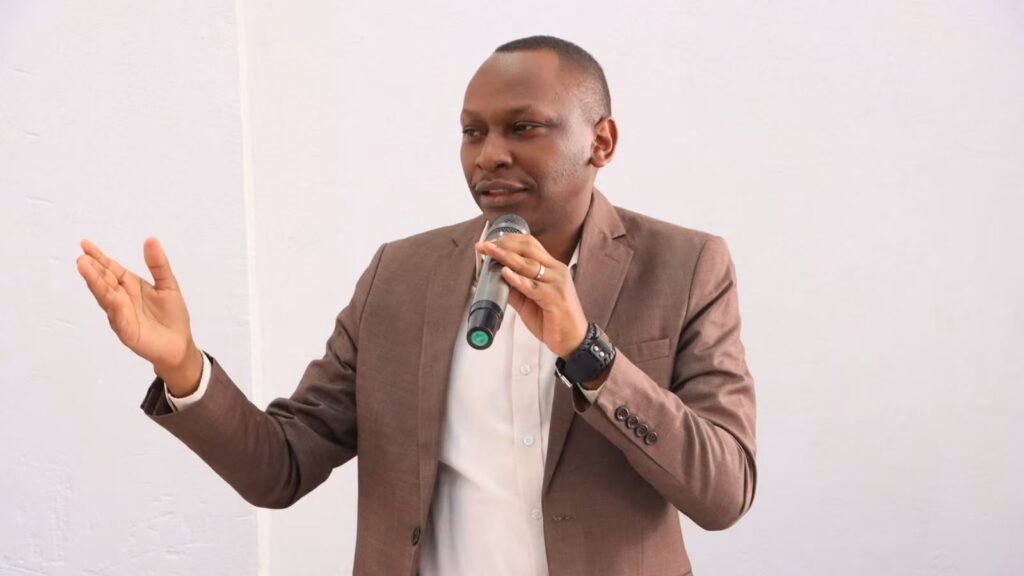
Before occupying one of the highest offices in Murang’a County, Deputy Governor Stephen Munania had to find creative ways of making ends meet while at university.
His campus business ventures included selling boiled eggs, preparing uji over the weekends and making fresh juice for sale after church services on Sundays.
The seemingly modest businesses were part of a journey that would eventually take him from student leadership and university activities to the county government, where he now serves as the deputy to Governor Irungu Kang’ata.
Campus life
In an interview with The Nairobian, Munania opened up about his university experiences, the hustles that helped him survive, his ambitions and the lessons he continues to carry into public service.
“I sold boiled eggs, prepared uji over the weekends and sold fresh juices after church on Sundays. This taught me how to survive, build and create opportunities for myself,” he said.
For Munania, university was not merely a place to acquire academic qualifications. It was also an opportunity to discover his abilities, develop relationships, learn independence and participate in leadership.
He studied for a Bachelor’s degree in Disaster Management and International Diplomacy at Masinde Muliro University of Science and Technology (MMUST), before pursuing a Master’s degree in International Relations and Diplomacy.
His involvement in student leadership, academics and the Christian Union exposed him to different experiences and challenges that helped shape his outlook.
“I was actively involved in student leadership, academics and Christian Union, which exposed me to different experiences, challenges and opportunities. I also made meaningful friendships, learned independence and discovered a lot about myself,” he recalled.
Munania university years also provided an opportunity to participate in activities outside the classroom. He was involved in the Christian Union’s church dance team and participated in Red Cross activities.
He also enjoyed road trips, exploring places around and outside campus and watching movies during his free time.
However, his university experience was not without its complexities. Asked about dating and relationships during campus life, he described them as “complex and consequential”.
He also maintained that he did not have a particular favourite or least favourite lecturer, saying he appreciated all his lecturers.

From student leadership to county politics
Munania’s interest in leadership began during his university years, when he became involved in student affairs and developed an interest in representing the interests of others.
His political journey would later take him into elective politics, culminating in his election as Murang’a Deputy Governor alongside Kang’ata in the 2022 General Election.
The two were formally elected and subsequently sworn into office on August 25, 2022, at Ihura Stadium in Murang’a.
Now serving in the county’s top leadership, Munania describes himself as a trained diplomat and a strong advocate for youth development.
He says his focus is on moving beyond discussions about the challenges facing young people to creating practical opportunities that enable them to participate in economic and political activities.
“I believe in moving beyond youth narratives to creating real opportunities for young people,” he said.
Among the initiatives he highlighted is the establishment of the Murang’a Youth Service (MYS), which combines community service, skills development and opportunities for young people to acquire practical experience.
The programme has become one of the county government’s key youth empowerment initiatives. According to the Kenya News Agency, 773 young people graduated from its sixth cohort in May 2026, bringing the reported number of beneficiaries since its establishment to 8,400.
Under the programme, recruited youths participate in activities such as town cleaning and environmental conservation before progressing to technical and vocational training.
The Council of Governors has also documented the programme’s model, which includes a community service phase followed by county-funded technical and vocational education intended to equip participants with skills for employment and self-employment.
For Munania, the ambition is to create an economy that can sustain employment opportunities for generations rather than relying solely on short-term interventions.
He said the county was also seeking investments that could create opportunities for university graduates, technical and vocational training graduates and young people with practical skills but without formal academic qualifications.
Another area he identified is the Murang’a Industrial Park, which he said is part of efforts to attract investment and expand employment opportunities.






Creating opportunities beyond employment
Munania’s youth agenda also extends to political participation and the involvement of young people in decision-making.
He believes that young people should not wait until they are older to occupy leadership positions or contribute to governance.
“Show up for opportunities, tell your story, build your capacity and participate in shaping the society you want to live in,” he advised.
His position is that young people should be allowed to express themselves freely, participate in governance and influence decisions affecting their future.
“My message is simple: show up, participate and take your place at the table. Leadership is not reserved for a particular age group,” he said.
Healthcare and agricultural priorities
Beyond youth empowerment, Munania outlined several interventions the county government is pursuing in healthcare and agriculture, two sectors that directly affect the livelihoods of Murang’a residents.
On healthcare, he said the county had expanded kidney dialysis services through a partnership with BenaCare.
He also pointed to surgical camps conducted by Spanish medical teams, which have provided specialised operations while offering training opportunities for local medical personnel.
Other initiatives include connecting public health facilities to reliable internet and exploring additional partnerships, including with the Slovakian Embassy.
Agriculture, meanwhile, remains central to the county’s economic development because of its importance to household incomes and employment.
Murang’a is a major agricultural county, with coffee, tea, avocado, macadamia, dairy, mangoes and maize among its key economic activities.
Munania said the county was supporting farmers through the Inua Mkulima and Guaranteed Minimum Returns programmes, which target value chains such as maize, sorghum, mangoes and dairy.
The county is also providing certified maize seeds and subsidised fertiliser to help reduce farmers’ production costs.
For mango farmers, he cited subsidies and market-linkage arrangements, including a partnership with Food for Education to supply school meal programmes.
In the dairy sector, he said the Murang’a County Creameries Cooperative Union was working to improve milk collection, cooling and processing, with a target of paying farmers Sh50 per litre.
The county is also advancing plans for the County Aggregation and Industrial Park, which is intended to improve storage, market access and value addition.
County project records identify the park in the Kimorori Wempa area of Maragua as a Ksh500 million project intended to reduce post-harvest losses, improve farmers’ incomes and create employment opportunities, particularly for young people and women.

The promises and challenges of leadership
As the county government works towards fulfilling its development commitments, Munania acknowledged that there is still more to be done.
He said the administration had prioritised equitable development across wards, accessible healthcare, education and youth opportunities since taking office.
Among the programmes he highlighted was Kangata Care, which he said had supported more than 40,000 households.
In education, he cited the provision of free porridge to 42,000 Early Childhood Development Education (ECDE) learners and plans to advance subsidised meals for primary and junior secondary school learners.
However, he acknowledged that limited resources remained a major obstacle to implementing all the county’s development commitments. “Growing public needs require substantial investment, infrastructure and partnerships,” he said.
The deputy governor added that the county was pursuing partnerships, improving its own-source revenue collection and attracting private investment to bridge the resource gap.
The county’s development priorities are also reflected in its planning documents, which identify agriculture, healthcare, youth empowerment, education, infrastructure and industrialisation as key areas of investment.
Asked about his responsibilities when the governor is unavailable, Munania said he supports the coordination of county departments, monitors ongoing projects, addresses implementation challenges and ensures essential services continue without unnecessary interruptions.
