

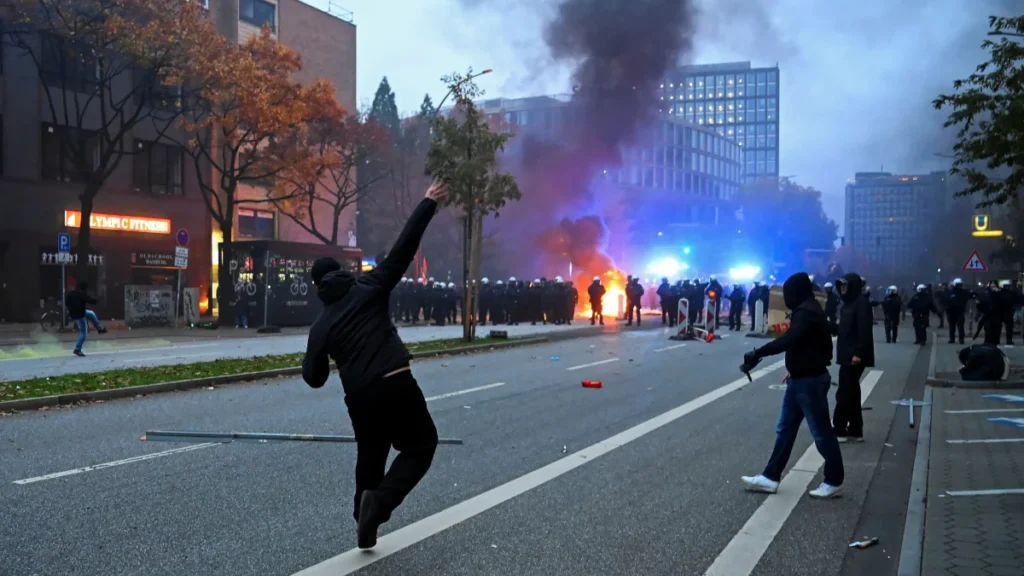
Tens of thousands of young people took to the streets across Germany this weekend in a nationwide wave of demonstrations against soaring living costs, underfunded education, and the prospect of compulsory military service, with largely peaceful daytime rallies in over 30 cities giving way to violent clashes and looting in Frankfurt, Cologne, and Hamburg after nightfall.
The protests, organized by the youth initiative “Gen Z regelt” (roughly, “Gen Z has got this”), were planned for 34 cities, including Berlin, Munich, and Leipzig. While organizers had hoped for a massive turnout, with over 182,000 people registering interest online, actual participation appeared significantly lower, with police in Frankfurt, Munich, and Berlin reporting a combined total of roughly 18,000 demonstrators, about half of the organizers’ own estimates for those cities. Nationwide, the alliance reported over 100,000 participants by the end of the day, according to German news agency dpa.
The demonstrations highlighted growing frustration among Germany’s youth, who felt their future was being compromised by a government they accused of prioritizing military spending over social welfare. The movement drew inspiration from similar youth-led protests that had swept across France, Italy, and other European nations in recent months.
At the heart of the discontent was a perceived misallocation of national resources. Protesters voiced outrage that while universities and social services faced budget cuts, the government was funneling billions into the military and expanding the Bundeswehr.
“Funding for education and social services are being cut, while the cost of living keeps rising,” said Veronika Dinter, a 23-year-old political science student and spokeswoman for the movement, who travelled from Hanover to Berlin. “Universities are struggling, institutes are closing, teachers are losing their jobs and education facilities are literally falling apart. This crisis is the political failure of our government. And instead of solving it, Chancellor Friedrich Merz and his rich friends are funding the military with billions of euros”.
The organizers outlined six central grievances, including the lack of investment in schools and healthcare, the rising cost of living, social injustice, and climate protection. A primary concern was the government’s recent push to increase the size of the armed forces, which sparked fears among young people that compulsory military service, abolished in 2011, could be reinstated.
“We are here to fight for peace and freedom, not for war and coercion,” Dinter stated, emphasizing that the movement advocated for better support of health and education systems and a fairer distribution of burdens.
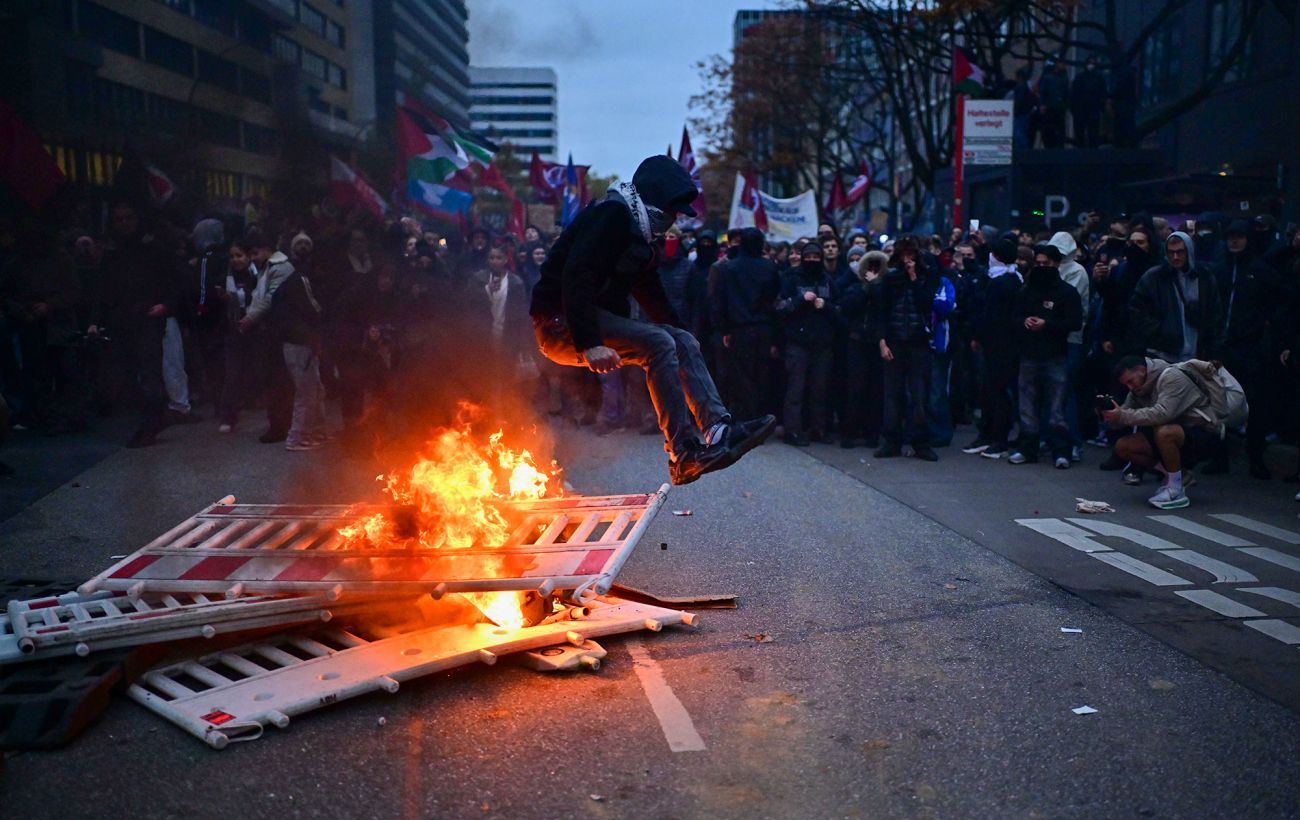
While the daytime atmosphere was described as largely peaceful, with families and students carrying placards and chanting slogans, tensions escalated after dark in several major cities.
In Frankfurt, Germany’s financial hub, police reported “violent riots” in the city centre. Masked individuals smashed shop windows and looted goods, while authorities said Molotov cocktails were thrown at emergency services. Police deployed water cannons and special units, and a weapons store was reportedly broken into.
 Who is Alice Huang? The Woman at the Centre of Nvidia CEO Jensen Huang Intelligence Allegations
 Six Dead, 15 Injured After Gunman Opens Fire in Poland’s Krakow
 Paraguay President Quits as Ruling Party Withdraws Support Amid Banking Scandal
 JD Vance Blames Israel War for Election Losses, Warns Party Against Ignoring Voters




Roman Poseck, the interior minister of the state of Hesse, condemned the violence, stating that “approximately 100 clearly identified left-wing extremists” had infiltrated the protests and warning against Germany following the model of recent riots in France.
Similar scenes unfolded in Cologne, where police used water cannons after demonstrators set off pyrotechnics, leading to the cancellation of a planned march. In Hamburg, barricades were set ablaze and officers were pelted with bottles and fireworks.
Authorities in multiple cities had anticipated potential unrest. Ahead of the protests, many businesses along Berlin’s Kurfürstendamm and other luxury shopping streets boarded up their windows and closed early.
The German protests were part of a wider European movement. On the same day, France witnessed massive demonstrations with over 300,000 participants, alongside smaller rallies in Italy, Spain, and Portugal, all centred on similar themes of economic inequality and government austerity.
Kilian Hampel, a senior research fellow at the University of Konstanz, noted that while frustration among young Germans had been building for years, recent mobilizations elsewhere in Europe had encouraged them to take their concerns to the streets. He described concerns over deteriorating educational infrastructure as “legitimate”, stressing that demonstrators needed to be heard.
Despite the violence that marred the evening, protesters maintained that their demands remained central to the demonstrations. One 18-year-old demonstrator in Munich, identified only as Steve, addressed the Chancellor directly.
“The government has no response to the issues we care about other than continuing to cut funding and adding to our burden. We will continue to exercise our fundamental right to assembly until you stop ignoring us”.
