

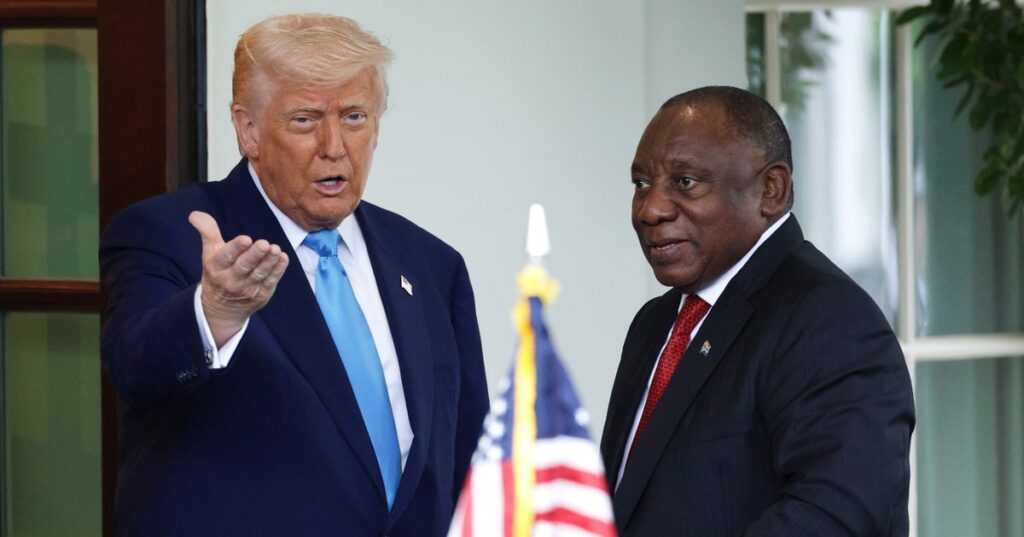
US President Donald Trump has moved to terminate Rwanda and South Africa from the African Growth and Opportunity Act (AGOA), threatening their access to preferential trade arrangements with the United States from January 1, 2027.
The decision was announced on November 2, 2026, after Trump notified Congress and the governments of the two African countries of his intention to end their participation in the trade preference programme.
US Trade Representative Jamieson Greer said the decision followed an annual review of sub-Saharan African countries’ eligibility for AGOA, which found that Rwanda and South Africa were engaging in practices that violated the programme’s requirements.
“The Office of the United States Trade Representative led the annual interagency review of sub-Saharan African countries’ eligibility for the AGOA trade preference program. Based on the review, President Trump found that the governments of Rwanda and South Africa are engaging in practices that are inconsistent with AGOA’s eligibility criteria,” Greer said.
He cited concerns over trade barriers, investment restrictions and issues that Washington considers threats to its national security and foreign policy interests in the region.
“These concerning and pervasive practices include, but are not limited to, barriers that undermine American trade and investment and practices that pose a threat to U.S. national security and foreign policy interests in the region,” he added.
The Trump administration said it expected the two countries to take steps to address the concerns and meet the eligibility requirements for continued participation in the programme.
The US Trade Representative outlined different concerns against the two countries in the announcement.
For Rwanda, Washington cited alleged shortcomings relating to trade and investment barriers, the rule of law, political pluralism, internationally recognised workers’ rights and human rights.
The Trump administration also raised concerns over Rwanda’s involvement in regional security matters and its foreign policy interests.
For South Africa, the concerns included barriers to American trade and investment, corruption and issues Washington considers threats to its national security and foreign policy interests.

The announcement, however, did not provide specific examples of the alleged trade barriers or other practices behind the decision.
The move comes amid deteriorating relations between Washington and Pretoria, with disagreements over South Africa’s domestic policies, its foreign policy positions and its diplomatic relations with countries including Iran.
 Democrats Make Historic Gains Across US as Trump Concedes Election Defeat
 JD Vance Blames Israel War for Election Losses, Warns Party Against Ignoring Voters
 Who Was Adam Robinson? The Tech Entrepreneur Killed in Florida Learjet Crash
 Texas Tech Entrepreneur, Wife and Two Toddlers Among Nine Killed in Florida Learjet Crash








Rwanda has also faced growing pressure from the United States over the conflict in eastern Democratic Republic of Congo (DRC), where Washington has accused Kigali of supporting the M23 rebel group. Rwanda has repeatedly disputed allegations of backing the rebels.
The US had previously suspended Rwanda’s eligibility for AGOA benefits covering apparel exports in 2018, although the country retained access to other eligible product categories.
The African Growth and Opportunity Act was enacted in 2000 under former US President Bill Clinton to strengthen trade and economic relations between the United States and sub-Saharan African countries.
The programme provides eligible African countries with preferential access to the American market, allowing thousands of products to enter the United States without import duties.
According to the Office of the US Trade Representative, AGOA covers more than 1,800 products, in addition to more than 5,000 products eligible for duty-free access under the Generalized System of Preferences programme.
Countries seeking to benefit from the programme must meet requirements relating to market-based economies, the rule of law, political pluralism, human rights, workers’ rights and the removal of barriers to American trade and investment.
The programme has undergone several reviews, with participating countries required to maintain the eligibility conditions.
South Africa has been among its biggest beneficiaries, exporting approximately US$1.7 billion (about KSh220 billion) worth of goods to the US under AGOA in 2025. Its exports include motor vehicle components, citrus products and wine.
Rwanda’s exports to the American market include coffee and minerals. The programme was extended by the US Congress in February 2026 through December 2026, following its expiry in September 2025.
If Trump’s proposed termination takes effect, Rwanda and South Africa will lose the preferential duty-free access they currently enjoy under AGOA from January 1, 2027, potentially increasing the cost of their exports to the American market.
The development could also affect businesses and workers in export-oriented sectors, particularly South Africa’s automotive and agricultural industries.
