
Alice Huang, also known as Huang Le, is a Chinese business executive and former top figure at Singapore-based data center firm Megaspeed International who U.S. intelligence officials believe was recruited by China’s Ministry of State Security to gather information on Nvidia CEO Jensen Huang and potentially influence access to advanced AI chips.
Public details about her are limited. She is a Chinese citizen, speaks good English, and is described as well-connected in the global AI chip industry.
A short online profile on a Chinese fund database (unverified by major outlets) listed prior roles including at HSBC bank and as a reporter for Chinese media outlets CCTV and Hunan TV. She is not related to Jensen Huang, the Taiwanese-born founder and CEO of Nvidia, despite sharing the same surname.
Alice served as a senior executive, previously listed as managing director, at Megaspeed (formerly linked to 7Road International and Chinese gaming interests). The firm positions itself as a core Nvidia cloud computing partner in the Asia-Pacific region, with operations or affiliations in Singapore, Malaysia, and Indonesia.
Megaspeed purchases large volumes of Nvidia chips to power data centers that provide computing resources, including to Chinese AI customers. Reports indicate it acquired more than $4.8 billion worth of chips over roughly two years, with a notable roughly $2 billion order around 2025.
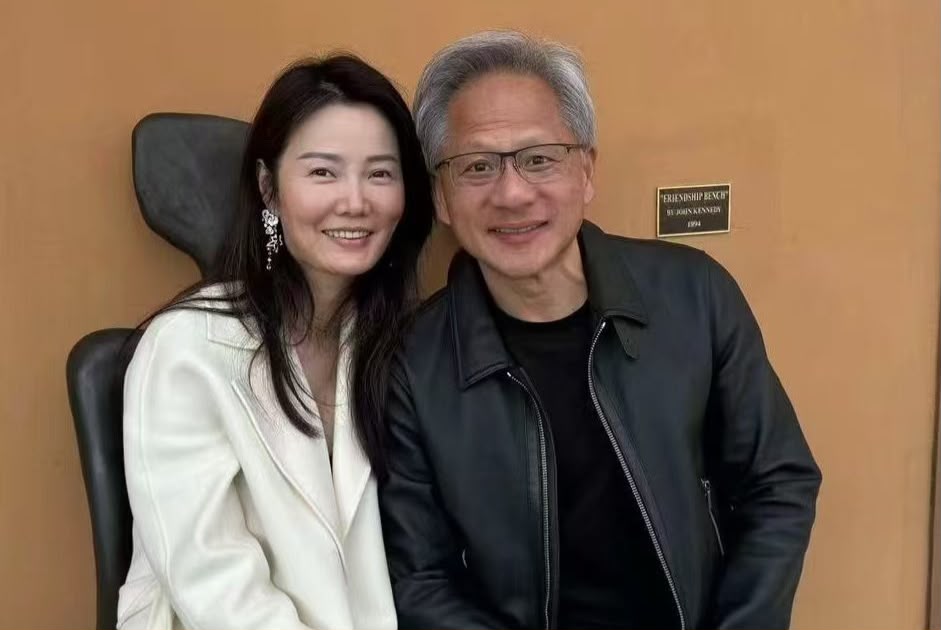
The relationship and surveillance
U.S. agencies had Alice under electronic surveillance for more than a year, initially over suspicions that she and Megaspeed were helping divert restricted advanced Nvidia AI chips to China in violation of U.S. export controls.
During that monitoring, officials identified communications with an American citizen who was later “unmasked” as Jensen Huang. Intelligence assessments concluded she had developed a close personal relationship with him and was acting as a Chinese intelligence asset.
The two were photographed together at an industry gathering in Taipei in 2024. In 2025, during Computex in Taipei, they were seen at a dinner hosted by Jensen Huang at a Chinese restaurant. Video and reports described him putting his arm around her as she kissed him on the cheek; she was later seen running her fingers down his lower back as they left the restaurant in the same car.
A classified memo circulated among senior Trump administration officials in spring 2026 described the relationship as intimate or romantic and stated that China’s Ministry of State Security had recruited her to collect intelligence on Jensen Huang, learn more about U.S. AI hardware, and possibly persuade Nvidia to advocate for broader access to its most advanced processors for China.








President Trump was briefed on the intelligence roughly a year earlier but took no public action at the time.
It remains unclear exactly what information, if any, was passed to Beijing, its value, or the precise timeline of any intelligence activity. The surveillance of Alice was reported as ongoing around the time of the initial New York Times disclosures in late October 2026.
She did not respond to media requests for comment. Megaspeed has denied wrongdoing on chip diversions, stating in late 2025 that prior reporting contained “misleading information and incorrect insinuations.” Nvidia previously investigated the diversion claims against the firm and said they were “thoroughly investigated and debunked.”

Company and official responses
On November 8, 2026, Jensen sent a message to Nvidia employees acknowledging the personal matter: “I was unfaithful to my wife. My actions hurt her and our children. There is no excuse for what I did. I am deeply sorry.” He pledged full cooperation with an inquiry.
Nvidia’s board announced an independent investigation, overseen by outside counsel, into whether the relationship involved a foreign intelligence effort or compromised company secrets or national security. The board stated it currently has “no reason to believe that either national security or NVIDIA secrets were compromised” and expressed continued confidence in Huang’s leadership.
An earlier company response described interactions with Alice Huang as “not unusual or unexpected,” noting that Jensen meets thousands of customer executives annually and that customers receive only ordinary business information, not trade secrets or national security details.
China rejected the allegations. Foreign Ministry spokesman Guo Jiakun said: “The report in question is based on groundless speculation and is nothing more than an attempt to smear China.” A Chinese Embassy spokesperson in Washington described U.S. claims as a campaign of “groundless smears and slanders.”
U.S. lawmakers, including chairs of House committees on China, foreign affairs, and intelligence, requested a closed-door briefing from Jensen Huang on the interactions and Nvidia’s counter-espionage measures.