

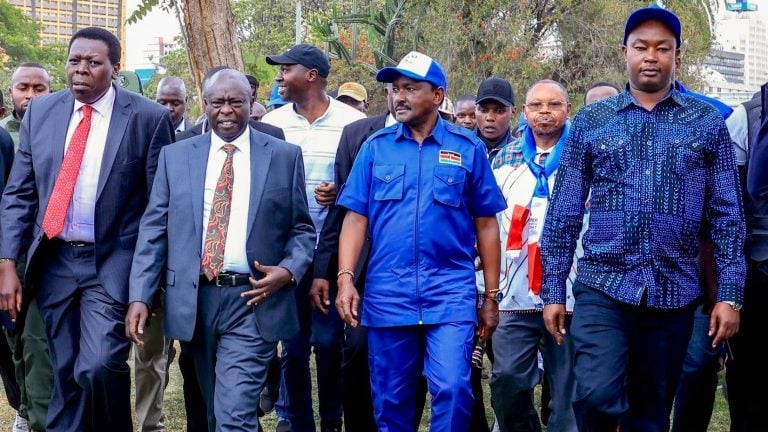
With nearly two years still to go before the August 2027 general election, Kenyan President William Ruto has already begun crisscrossing the country, using development projects as cover to launch his re-election campaign. Yet the “United Opposition” that is supposed to counter him has fallen into an open, multi-front internal brawl. From rally grounds in Nairobi to church fundraising events in Nyeri County, opposition leaders shout unity while accusing one another of “political bullying,” “tribal arithmetic,” and “arrogance.”
This infighting not only exposes fundamental disagreements over the opposition’s candidate-selection mechanism but also reveals a deeper structural predicament: under Kenya’s “winner-takes-all” electoral logic, every faction is using its regional vote bank as a bargaining chip, yet no one is truly setting about building a national campaign machine capable of crossing ethnic boundaries.
In early November 2026, the rift became fully public. Rigathi Gachagua, leader of the Democratic Party of Kenya (DCP) and former deputy president, threw out a “three-man alliance” proposal in a media interview, claiming that if he, Wiper Party leader Kalonzo Musyoka, and Nairobi Senator Edwin Sifuna joined forces, it would be enough to drive Ruto from power. He went further, offering a specific “numbers ledger”: he himself controlled roughly 10 million votes in the Mount Kenya region, Kalonzo had 4 million, and Sifuna could bring 3 million.
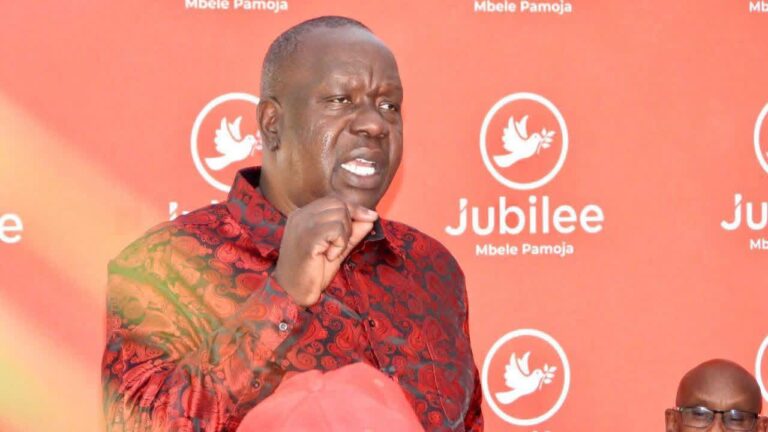
These remarks swiftly ignited a powder keg within the opposition. Jubilee Party leader Fred Matiang’i – himself harboring presidential ambitions – publicly denounced this “majoritarian arrogance” as precisely the culprit dividing the opposition.
Matiang’i warned that treating political communities as voting blocs and letting a handful of leaders decide the opposition’s direction would only make unity more remote. Democratic Party leader Justin Muturi also joined the fray, accusing Gachagua of “political bullying” and “double-talk.”
Faced with the accusations, Gachagua’s response was to downplay the dispute as “competition among brothers.” On November 8, Matiang’i posted a photo on social media with Gachagua and Kalonzo, captioned “Brothers will always put Kenya first.”
On the surface, the crisis seemed dissolved by a handshake. But the core questions remained untouched: Who will be the single presidential candidate? By what standard will that person be chosen? Until these two questions are resolved, any photo is merely a temporary ceasefire.
Gachagua’s “numbers argument” infuriated colleagues not only because of its posture but because it punctured the real logic beneath the opposition’s unity rhetoric: everyone is pricing themselves by their ethnic vote bank rather than wooing voters with a common political program.
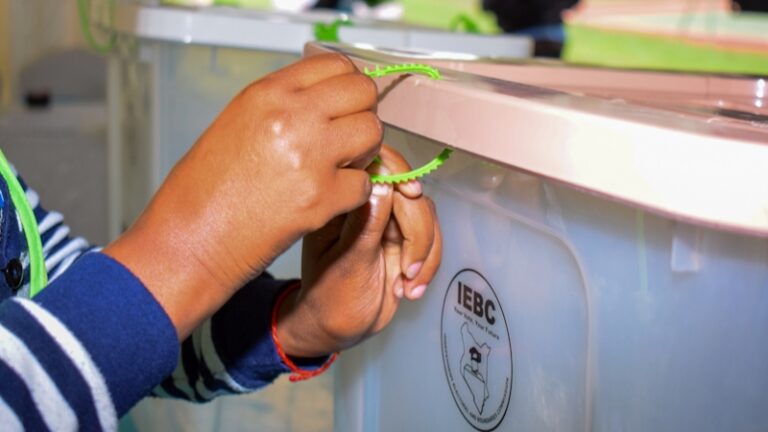
According to 2022 Independent Electoral and Boundaries Commission (IEBC) voter registration data, the 10 counties of the Mount Kenya region have about 5.77 million registered voters, the three Ukambani counties about 1.7 million, and the five western counties about 2.62 million. Gachagua’s arithmetic simply adds these blocs together, assuming voters within them will follow their respective “leaders” as if taking orders.
But political analysts point out that presidential elections cannot be reduced to regional arithmetic. One commentator put it bluntly: “Gachagua may believe he controls the numbers through Mount Kenya, but presidential politics cannot be reduced to regional arithmetic.”
More critically, this “who needs whom” debate diverts the resources and attention the opposition should be investing. Jeremiah Kioni, deputy leader of the Jubilee Party, warned that open divisions and personal attacks would only let the incumbent reap the benefits.
And indeed, Ruto’s camp is already exploiting this. During a tour of the Gusii region, the president himself mocked without concealment: “They are divided before they even begin the journey. They are quarreling with each other. Only people without a plan fight among themselves.”
While Gachagua and Matiang’i confront each other publicly, another opposition force that had been widely expected to deliver- the Linda Mwananchi movement – is also going through its own growing pains. This platform, which initially rose by attracting young voters, was quickly afflicted by the old maladies of traditional opposition politics: personality cults, regional power games, competing presidential ambitions, and leaders unwilling to hand over their respective political machines for the larger cause.
The core conflict revolves around the presidential ambitions of Nairobi Senator Sifuna and Siaya Governor James Orengo. Sifuna’s supporters insist he has already established himself as the movement’s presidential candidate, while Orengo’s announcement of his candidacy is interpreted as undermining Sifuna.
Meanwhile, Trans Nzoia Governor George Natembeya is accused of using his influence to reorder the movement’s internal hierarchy and sideline early founders. Saboti constituency MP Caleb Amisi – a politician who initially helped create the movement and later broke away – said bluntly that Natembeya had “hijacked” the movement’s direction.
The cost of this infighting is substantive. While opposition leaders compete for credit at rallies and trade barbs on social media, the time they should be using to register parties, build national branches, and train polling-station agents is slipping away.
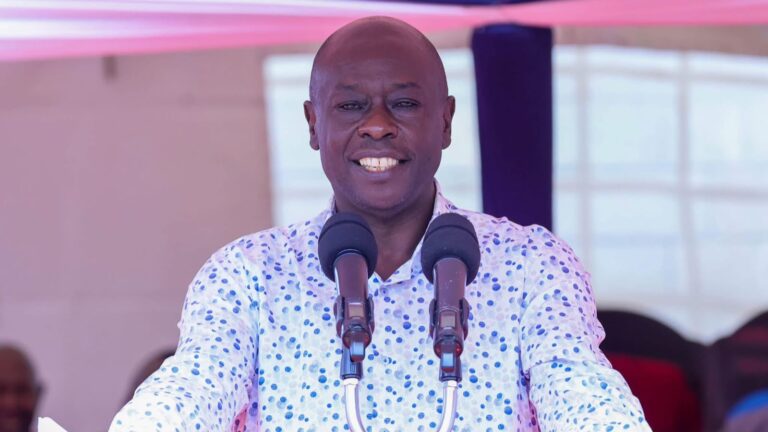
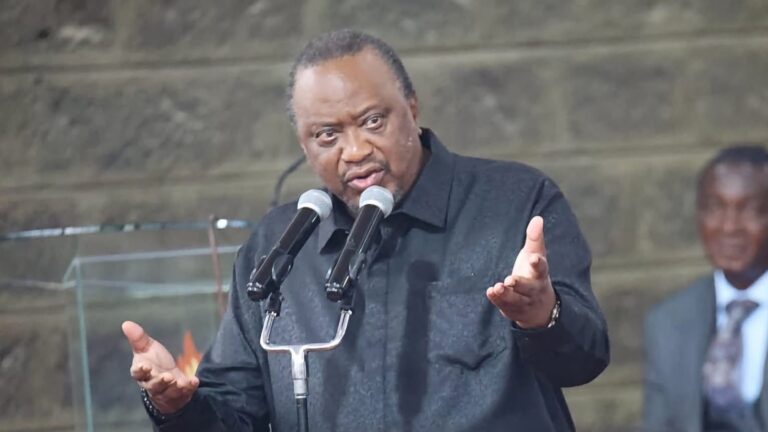

In early November, Sifuna unveiled the Linda Mwananchi Party’s “dream team” and promised to cover all 47 counties by November 30, but a party that has not yet resolved its internal leadership problem is bound to have limited capacity for expansion.
From Ruto’s perspective, the opposition’s infighting is a strategic gift. In 2022, he won with 50.49 percent of the vote, facing a largely unified opposition. Today, the opposition is split into at least four competing blocs: the government-aligned ODM faction, the Linda Mwananchi rebel faction represented by Sifuna and Babu Owino, Kalonzo’s Wiper Party, and Gachagua’s DCP-Jubilee remnants.
These blocs are competing for overlapping voter groups. The government-aligned ODM faction retains influence in Homa Bay, Kisumu, Siaya, and Migori; Wiper has deep roots in Ukambani; Linda Mwananchi seeks to attract young, urbanized, and reform-minded voters; and Gachagua is consolidating his base in Mount Kenya.
If these blocs each fight alone, Ruto need only maintain his Rift Valley base (about 7.2 million registered voters) and exploit ODM’s internal divisions in the Luo-Nyanza region (about 2.3 million) to nibble away at opposition votes, and that would be enough to win in the first round.
ODM MP Peter Kaluma’s social media remark, though exaggerated, captures the cruel arithmetic: “ODM has the ability to make Ruto win 80 percent of the vote.” He does not mean Ruto would actually get 80 percent, but that if the opposition remains divided, Ruto’s margin of victory could far exceed expectations.
Beneath all the surface divisions, the deepest problem the opposition faces may be its ideological emptiness. Ruto’s mockery in the Gusii region, though politically charged, is not entirely baseless: “They have no plan, no agenda, no policy, no vision. They don’t know how to build roads, how to build houses, how to provide healthcare.”
This of course ignores the incumbent’s own governance controversies, but it touches on a fact: the opposition’s public existence revolves almost entirely around “defeating Ruto” rather than around “what to do after defeating Ruto.” United Opposition spokesman Muhisa Kituyi warned as early as May 2026 that the opposition must position itself as a “solutions-driven force” rather than merely engaging in political mudslinging with the president.
Kituyi also pointed out that the coalition lacks an institutionalized unity mechanism – “the mechanism to keep everyone at the table is underdeveloped.”
This institutional vacuum is especially evident in the candidate-selection question. Matiang’i advocates selecting candidates through an “inclusive process” based on competence, qualifications, and track record, rather than on ethnic voting blocs. Gachagua insists on negotiating from “known” regional vote banks. There is no middle ground between the two logics, and any concession by either side means a substantive loss of political capital.
Opposition leaders are not unaware of the seriousness of the problem. At a church fundraising event in Nyeri, Matiang’i promised to deliver victory with “military precision” and said the opposition would assemble a “completely invincible team.” The photo of Kalonzo, Gachagua, and Matiang’i was also deliberately released to reassure supporters.
The Jubilee Party even established a committee led by Senator Kembi Gitura specifically tasked with negotiating alliances with other opposition parties.
But there is an obvious time lag between these gestures and mechanisms. The committee has published no negotiation timetable, has not said which parties will be approached first, and has not answered the most critical question: if negotiations fail, is there a binding mechanism to prevent the loser from bolting? The lesson of 2022 is not distant – the opposition’s division allowed Ruto to win by a narrow margin. Today, the degree of fragmentation far exceeds that of that year.
Meanwhile, Ruto’s development tours are pressing ahead. Deputy President Kithure Kindiki declared at a rally in the Coast region that the government is implementing development projects equally across all 47 counties, “regardless of party affiliation,” and asserted that the opposition would “struggle to compete with Ruto in 2027 because his development record speaks for itself.” Whether or not this claim withstands factual scrutiny, its political effect is clear: the incumbent is using state resources to construct a “performance narrative,” while the opposition has not yet produced even a unified “alternative narrative.”
By Erick Otieno
