

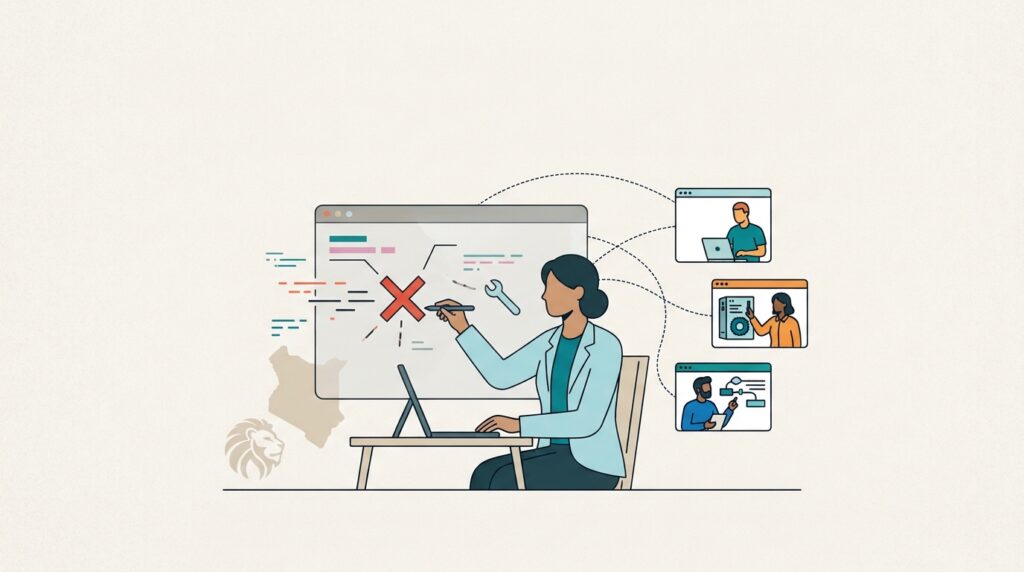
Kenya’s artificial intelligence strategy should produce something that an employer can actually inspect: proof that a worker knows when a machine is wrong. Every new training certificate should be paired with evidence from a real task, including a correction the trainee made and a judgment call the software could not responsibly make alone.
Kenya has ambitions to build a substantial AI economy. The Ministry of Information, Communications and the Digital Economy’s digital-skills program distinguishes basic, intermediate and advanced skills, and recognizes that workers must learn to critically evaluate technology. The ministry’s AI strategy and implementation materials also set out a broader direction for investment in talent and infrastructure. The question is how to translate those aspirations into skills that last beyond the next software update.
The African Union’s November 2-6 education and technology meeting connected responsible AI, innovation, training and decent employment. A November 4 International Labour Organization policy brief makes the same broad point: developing economies have time to direct AI toward work that complements people, but delay and weak foundations could widen existing gaps. Kenya can turn this policy challenge into a simple operational rule.
A training provider or publicly funded apprenticeship should ask each learner to complete three assignments. First, improve a real workflow, such as sorting customer inquiries, reviewing a nonconfidential purchase order or comparing instructions against an approved public source. Second, find a deliberately planted error in the AI output. Third, explain when the task must return to a qualified human.
For a small Kenyan exporter, that might mean checking a multilingual buyer message before the company quotes a price or promises a shipment date. For an agricultural cooperative, it might mean spotting a mismatch between a member’s delivery record and a payment summary. For a county office, it might mean refusing to give a definitive answer where a public regulation is ambiguous. The tasks need not require sophisticated programming. They require attention, domain knowledge and the willingness to ask a better question.
The evidence should travel with the worker. A short portfolio could record the task, the permitted tools, the source information, the original time or error rate, the final result and the corrections made. The trainee should also describe one instance where they withheld the answer or sought review. Employers could then assess what someone can actually do, without treating a certificate as proof of operational judgment.
This would help address a familiar problem with digital training: someone who knows the vocabulary may still be unable to manage a customer’s exception or check a number. The distinction becomes more important when AI makes weak work look polished. A fluent answer can conceal an invented source, a missing requirement or an overconfident recommendation.




For employers, a portfolio provides a clearer hiring signal. For training organizations, it provides feedback about which exercises produce useful skills. For government, it creates a basis for evaluating public spending. Funders could measure completed work and demonstrated corrections instead of counting registrations, prompts entered or certificates issued.
Training also needs to reach beyond major cities. A rural business with intermittent connectivity should be able to practice on low-bandwidth tools, downloaded documents or supervised simulations. The assessment should reward good reasoning and sound source checks rather than access to the newest paid model. Otherwise, Kenya risks building a workforce credential that reflects who could afford the tools.
People need protected practice time. Employers who want job-ready graduates should offer paid, short projects that expose trainees to actual business constraints. Students should not have to provide free labor merely to prove that they deserve experience. A small employer can start with a single assignment and a supervisor who reviews it once a week.
AI will keep changing. The durable advantage lies in workers who can learn a new tool, understand what it may miss, catch the costly mistake and explain their decision to someone else. Kenya should make that ability visible in its next phase of AI investment. A portfolio with one well-documented correction may be worth more to an employer than ten certificates that never tested judgment.
Gleb Tsipursky, PhD, is a behavioral scientist, CEO of Disaster Avoidance Experts, and author of The Psychology of AI Adoption at Work: From Resistance to Results (Georgetown University Press, 2026).
