

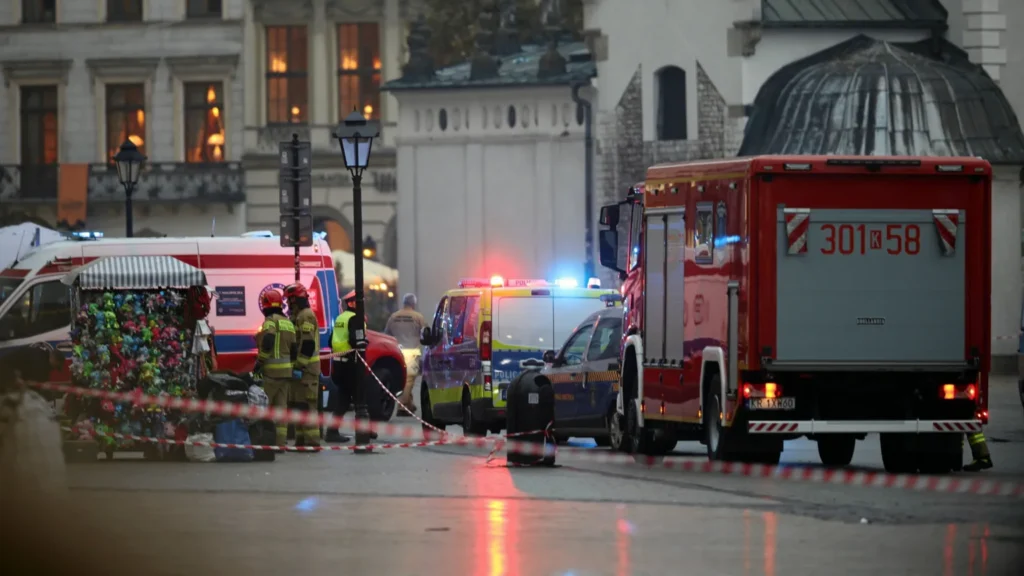
A gunman opened fire on random pedestrians in Krakow’s historic Main Market Square on Saturday afternoon, killing six people and wounding at least 15 others before being shot and arrested by police, authorities said.
The attack, which began shortly before 3 p.m. local time, sent tourists and residents fleeing through one of Europe’s largest medieval squares as a man in military-style clothing fired from a moving vehicle.
Among the wounded were two police officers who engaged the suspect. One remained in critical condition after suffering three gunshot wounds and undergoing surgery, Interior Minister Marcin Kierwiński said.
Police identified the suspect as a 24-year-old Polish citizen who acted alone. Małopolska Police spokesperson Katarzyna Cisło said the man wore military fatigues and a bulletproof vest and used a military-type long gun.
Officers found “many other weapons, as well as ammunition” in his car. The suspect was shot during his arrest and taken to a hospital. Police said the public was no longer in danger.
Polish Prime Minister Donald Tusk, who travelled to Krakow following the attack, confirmed he was being kept informed by the interior ministry and praised the officers who intervened.
Tusk appealed to politicians against using the incident for political purposes, writing on X: “A heartfelt appeal to politicians of all stripes: do not exploit this tragedy,” Tusk wrote on X. “We will establish all the circumstances of this crime”.
President Karol Nawrocki said he was “deeply concerned” and awaited a full explanation of the events.
Krakow Mayor Łukasz Gibała urged residents to remain calm and act responsibly, saying “our thoughts are with the victims’ loved ones”. The city announced a period of mourning through Nov. 11.
The US ambassador to Poland, Tom Rose, described the attack as a “savage and murderous attack that’s shattered the peace of Poland,” while EU foreign policy chief Kaja Kallas said the tragedy “will be felt far beyond Poland”.
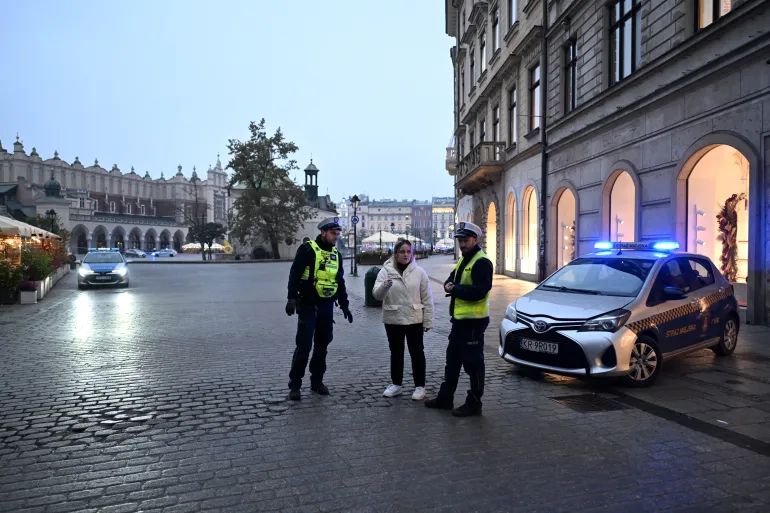
The shooting unfolded in a square that typically teems with visitors on a Saturday. About 15 million tourists annually visit Krakow, Poland’s second-largest city, and most pass through the Main Square.
Witnesses described scenes of panic as the gunman drove into the square and began firing.
 Poland’s Constitutional Crisis Erupts Into Overnight Standoff as President Rushes Home
 Who is Alice Huang? The Woman at the Centre of Nvidia CEO Jensen Huang Intelligence Allegations
 Paraguay President Quits as Ruling Party Withdraws Support Amid Banking Scandal
 JD Vance Blames Israel War for Election Losses, Warns Party Against Ignoring Voters



Jonathan Balshaw, a visitor from Ipswich, England, told the BBC he and his girlfriend hid behind St. Mary’s Basilica. “A lot of shots were fired, more than 20, with it sounding like multiple different firearms – there were two distinctly different noises,” he said.
Another witness told Reuters she ran into a restaurant and waited upstairs for silence but heard only the sound of a rescue helicopter.
A tram operated by Krakow’s public transport provider was also shot at near All Saints’ Square, shattering the driver’s cab window, although no one on board was injured.
The motive remains unknown. Polish media reported, citing unnamed sources, that the suspect was a former soldier and that the vehicle he used was registered to his father.
Prosecutors and police remained at the scene Saturday evening as investigators worked to secure evidence and establish the circumstances of the attack.
Saturday’s attack stunned Poland, a country where mass shootings are exceptionally rare and where Krakow’s Main Square, a UNESCO World Heritage site surrounded by cafes, churches and historic trading halls, has long symbolised the city’s resilience and openness to the world.
The violence comes amid a tense political period in Poland, with ongoing disputes over the Constitutional Tribunal and frequent demonstrations in major cities.
A right-wing gathering had been taking place near the Main Square on the day of the shooting, although police said there was no immediate indication of a connection between the event and the attack.
The attack also reflects wider European concerns about lone-actor violence in public spaces. In recent years, major tourist hubs across the continent have grappled with how to protect crowded squares and landmarks without turning them into heavily secured areas.
Krakow’s Main Square, with its wide pedestrian zones and limited vehicle access points, had historically been considered low-risk, a perception now challenged by the shooting.
